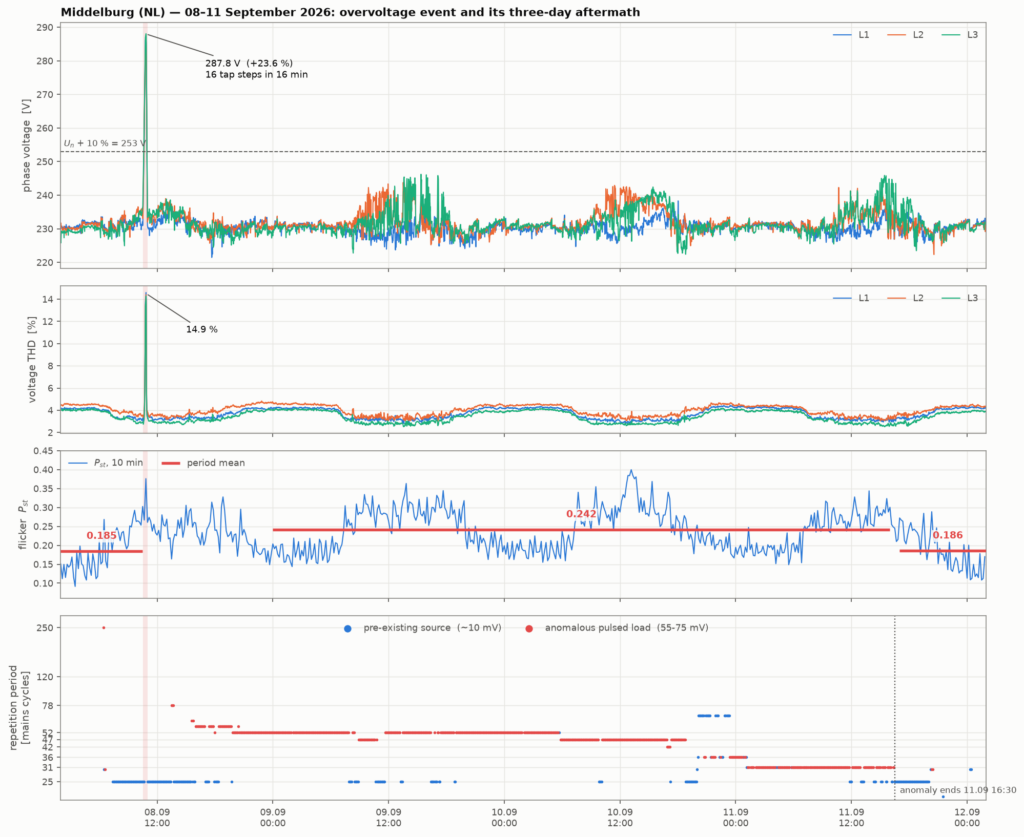
On September 8, 2026 at one of the PQopen measurements in the Netherlands reported a voltage swell of about 20 minutes duration with a maximum level of up to 289 V.

This report shows in detail what was measured and what the possible root cause was. Additionally to the event itself, there was a change in the voltage’s „fingerprint“ for a couple of days until it was normalized again.
Summary
Three separate findings, in causal order.
1. The swell was a voltage-regulator runaway, not a network fault: Between 10:31:47 and 10:46:47 the voltage rose in 16 discrete steps at intervals of exactly 60.0 s, each step +1.11 % ± 0.08 % of the prevailing voltage. It held at the top for 5 min 49 s, then was brought back down in 17 steps at irregular 3–60 s intervals. All three phases rose together by 22.8–23.8 %, peaking at 287.8 / 286.6 / 288.8 V. Constant relative step size, a rigid 60 s cadence, a plateau, and a manual-looking return is the signature of an on-load tap changer or line voltage regulator driven to its raise limit — most plausibly by a false low-voltage reference on the regulating relay. It is not a fault, not a load rejection, and not an LV neutral problem.
2. The THD rise is transformer core saturation: THD went from 3.4 % to 14.9 %, but only above ~260 V (1.13 pu), and then exponentially — doubling for every 2.3 % of further overvoltage. The THD-versus-voltage curve is single-valued: the rising and falling branches lie exactly on top of each other, so the distortion is a static function of the instantaneous voltage. Odd harmonics rose ×2.28 while even harmonics did not move (×0.84), identically on all three phases. That combination — symmetric, instantaneous, exponential above a knee — is steady-state over-excitation of iron, not inrush and not a converter.
3. The changed power spectrum: The PSD change is not broadband: it is a harmonic comb that appeared as the voltage was being stepped back down (≈10:53–11:00 on 08.09) and stopped at ≈16:30 on 11.09.
Causal chain: The regulator runaway (1) drove the local network 23 % over nominal for 20 minutes. The harmonic rise (2) is the passive response of transformer iron to that voltage and ended with it. The spectral change (3) is a downstream consequence: a grid-synchronised, integer-cycle switching controller on or near this LV feeder was knocked out of its normal duty by the excursion, ran in an abnormal mode with a progressively shortening cycle for three days, and returned to normal on the afternoon of 11.09 — at which moment the pre-existing N = 25 pattern, absent throughout, came back.
Press/Newspaper
To confirm this as real issue, I was informed from local people, that there were some news articles mentioning some problems with the local electricity grid in the Middelburg area. Here is a translation of a local newspaper, no mentioning the kind of issue. There was no power cut or outage, just devices broken down due to high voltage:
https://wijzijndestad.com/verhalen/schade-na-spanningspiek-in-middelburg-meld-het-bij-stedin
The major power cut in Middelburg on Tuesday 8 September appears to have been caused by human error during work carried out by network operator Stedin. Stedin has confirmed this to the PZC.
The consequences were severe in some places. The PZC spoke to business owners whose air-conditioning units, ovens, freezers, lighting, alarms and doorbells had broken down. The newspaper also spoke to Jessica van Stee from Hotel Sint Joris on Balans. We also got in touch with her briefly via Instagram. At the hotel, smoke was coming from the meter cupboard near the lift. The hotel was evacuated as a precaution. The lift broke down and some rooms had to be aired out due to the smell of burnt plastic.We also spoke to a business owner whose lighting had all burnt out and whose lift had broken down following the power surge. Fortunately, it all ended well, but it does show that the consequences could have been much worse.
Fred de Bruijne, chairman of the Middelburg Business Association (VOM), told the PZC that numerous reports of damage were circulating in the business owners’ WhatsApp group. At De Drvkkery itself, too, light bulbs and the bell at the suppliers’ entrance were damaged.
According to a spokesperson for Stedin, the power surge was caused by human error during maintenance work. The company told the PZC that this is “extremely unfortunate” and that Stedin intends to learn from it to prevent a recurrence.
Translated with DeepL.com (free version)
Data used
| Dataset | Resolution | Channels |
|---|---|---|
Cycle-by-Cycle Freq RMS | one value per mains cycle (20 ms) | Freq, U1_1p_rms |
Voltage RMS THD 1s | 1 s | U1..U3_rms, U1..U3_THD |
Voltage Harmonics Interharmonics etc | 10 min | harmonics H0–H50, interharmonics, 5 Hz LF bins, 1 kHz HF bins, unbalance, Pst |
The swell
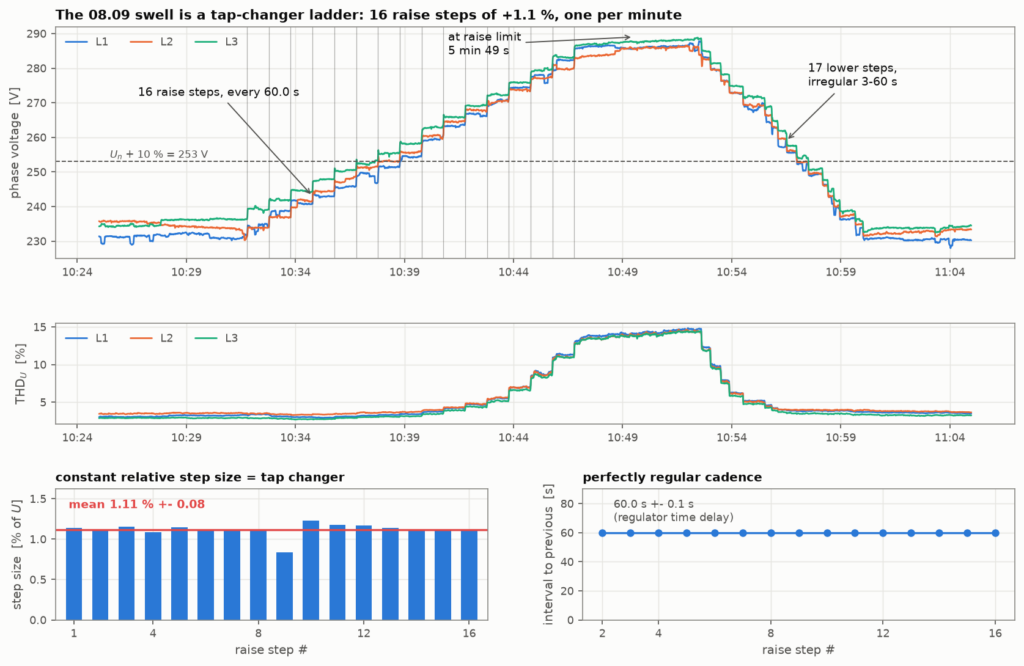
marked. Middle: voltage THD. Bottom left: step size as a percentage of the voltage before
each step. Bottom right: interval between successive raise steps.
2.1 Timing and magnitude
| Quantity | Value |
|---|---|
| First raise step | 08.09 10:31:47 |
| Raise steps | 16, at 10:31:47 + k × 60.0 s (each at :47 s, σ < 0.1 s) |
| Step size | +1.114 % ± 0.080 % of the voltage before the step |
| Last raise step | 10:46:47 |
| Plateau at the raise limit | 10:46:47 → 10:52:36 (5 min 49 s) |
| Lower steps | 17, irregular intervals 3–60 s, 10:52:36 → 11:00:01 |
| Peak voltage | L1 287.79 V (10:52:31), L2 286.59 V, L3 288.82 V |
| Rise, peak vs. 09:00–10:00 mean | L1 +23.6 %, L2 +22.8 %, L3 +23.8 % |
| Above 253 V (Un+10 %) | 10:36:48 → 10:57:31, 19.9 min on at least one phase |
| Above 270 V | 12.8 min |
| Above 280 V | 7.8 min |
Why this is a tap changer
Four independent features point the same way:
- Constant relative step size. The absolute step grows from +2.6 V at 232 V to +3.1 V at 282 V, but the ratio holds at 1.11 %. A regulating winding changes a turns ratio, so it produces a constant percentage; a load or generation change would not.
- A rigid 60.0 s cadence on the way up. This is a regulating relay’s time-delay setting, not a mechanism speed (a runaway contactor would step every few seconds) and not human action.
- A plateau. The voltage stops rising and sits flat for almost six minutes before reversing — the behaviour of a controller that has reached its end stop, not of a disturbance that decays.
- An irregular return. Down-steps at 3, 6, 9, 15, 21, 27, 38, 60 s. Whatever drove the descent was not the same 60 s timer; manual or remote intervention is the natural reading.
Sixteen steps of 1.11 % is about +19 % of ratio, consistent with a regulator running from approximately mid-position to a +16-tap limit. The perfectly balanced rise across all three phases places the source upstream on the MV side; a neutral or LV problem would have raised some phases and depressed others.
The plausible trigger – to be confirmed – is a false low-voltage reference on the regulating relay (for example a failed VT circuit or fuse): the relay sees a collapsing measurement, raises once per time-delay interval, and keeps raising until the tap limit blocks it. The data cannot distinguish this from other reference faults, but it does exclude a network fault, a load rejection, and an LV-side cause.
The harmonic rise
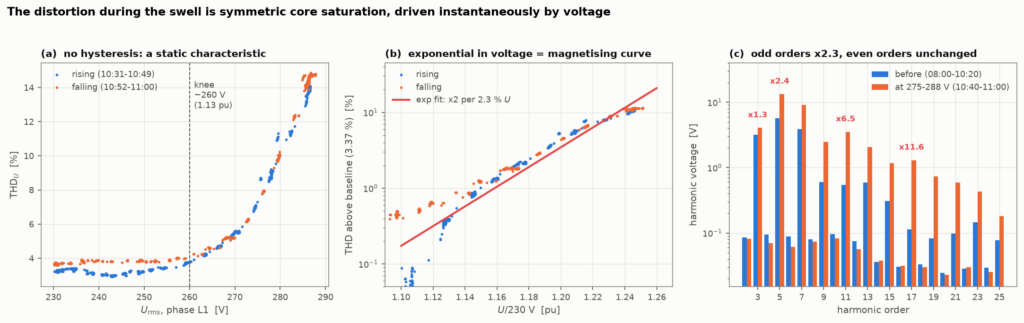
The evidence
| Observation | Value | What it rules in / out |
|---|---|---|
| Baseline THD | 3.37 % | — |
| Onset of measurable excess | ~260 V = 1.13 pu | a knee, i.e. a saturable magnetic circuit |
| Growth above the knee | ×2 per 2.3 % of voltage | exponential magnetising current, not a linear source |
| Rise vs. fall branches | superimposed, no hysteresis | instantaneous response; excludes remanence/inrush |
| Odd orders (3–25) total | 7.64 V → 17.44 V (×2.28) | strong odd-order generation |
| Even orders (2–24) total | 0.226 V → 0.190 V (×0.84) | half-wave symmetric; excludes inrush and DC bias |
| Identical on L1/L2/L3 | yes | balanced three-phase over-excitation |
| 1–2 kHz band | 0.94 V → 4.64 V (×4.9) | narrowing current pulse — deep saturation |
| Peak THD | 14.85 / 14.66 / 14.47 % | — |
Interpretation
Above the knee of the B–H curve the magnetising current of a transformer becomes a narrow, strongly peaked, half-wave-symmetric pulse; flowing through the network impedance it distorts the voltage. Every property in the table follows from that and from nothing else on the candidate list. In particular:
- Not inrush. Inrush is asymmetric — large even harmonics and a DC offset — and it decays. Here the even orders are flat and the distortion tracks the voltage step for step, up and down, for 20 minutes.
- Not a converter or a nonlinear load. Those do not switch on at a voltage threshold and then grow exponentially with a doubling constant of 2.3 %.
- Consistent with a Dyn distribution transformer. The 3rd harmonic is the least responsive order despite triplens being the largest component of a symmetric magnetising current. In a delta-primary transformer the zero-sequence triplens circulate inside the delta and never reach the MV network, so they contribute little to the LV phase voltage; the 5th and 7th are not zero-sequence and do propagate. That is exactly the ordering observed.
Consequence: nothing persisted. THD, all individual harmonic orders, the 1–2 kHz band and the unbalance returned to their pre-event values as soon as the voltage did. Whatever changed the PSD for the next three days is not a lingering harmonic effect of the swell.
The three-day change in the power spectrum
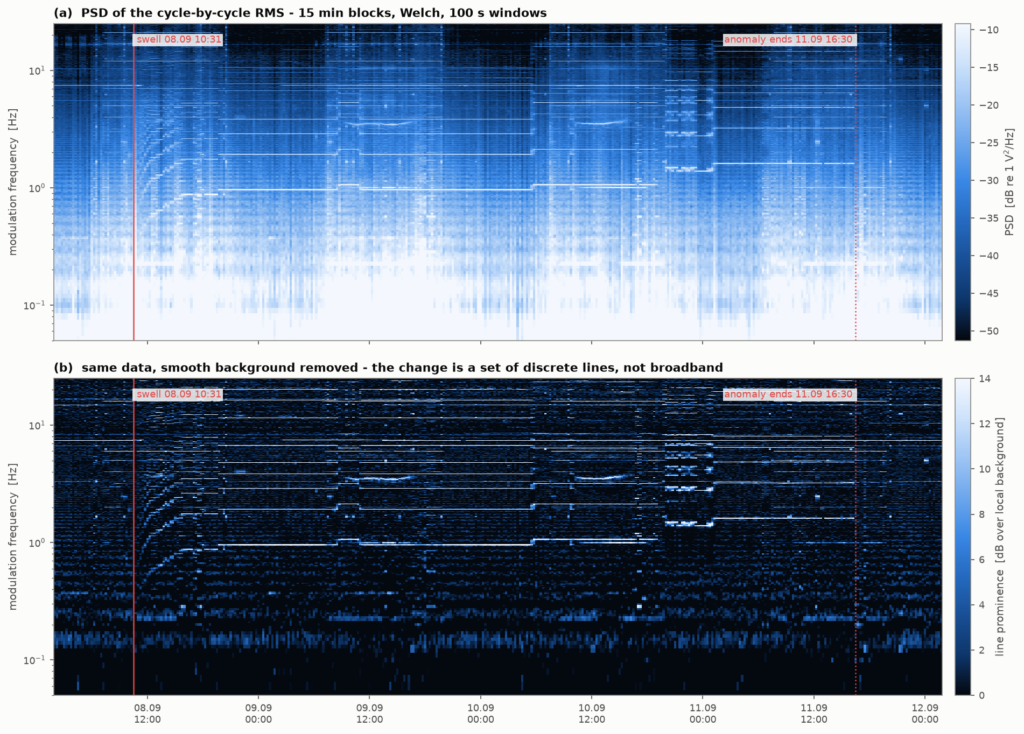
It is a harmonic comb, and it is new
Pre-event (08.09 03:00) the spectrum contains a fixed set of lines at 3.334, 5.352, 5.556, 6.250, 6.666 and 7.460 Hz, and nothing near 1 Hz. From the evening of 08.09 a strong, exactly harmonic comb dominates:
| Date / time | Fundamental | Harmonics detected |
|---|---|---|
| 08.09 03:00 (pre-event) | — | no comb |
| 08.09 20:00 → 10.09 early | 0.9615 Hz | 1.924, 2.884, 3.846, 4.808, 5.770, 6.730, 7.692 |
| 10.09 day | 1.0638 Hz | ×2 … ×7 |
| 10.09 23:25 → 11.09 01:05 | 1.3889 Hz | 2.778, 4.166, 5.556, 6.944 |
| 11.09 01:35 → 16:30 | 1.6129 Hz | 3.226, 4.838, 6.452 |
| 11.09 23:00 (after) | — | back to the pre-event set exactly |
What kind of device this is
The fingerprint is specific:
- synchronised to the mains and counting whole cycles, not milliseconds;
- a fixed burst of about 6 cycles, repeated at a period the controller varies in 5-cycle (100 ms) decrements;
- a voltage dip of a few hundred millivolts — a real appliance-sized load, close enough to the monitoring point to be visible at 0.13 %;
- running continuously for three days including nights, so not shift-bound;
- triggered at the moment of a 23 % overvoltage excursion and cleared three days later.
That is the behaviour of an integer-cycle / burst-firing power controller — the class used for resistive heating, and also the retry behaviour of a switch-mode supply in hiccup mode. The progressive shortening of the cycle over three days, then an abrupt stop, is consistent with a controller that was left in an abnormal duty by the excursion and was reset or recovered on the afternoon of 11.09.
Conclusion
This event shows what high-resolution power quality measurements can reveal that conventional grid monitoring misses entirely. Without a PQopen data at this location, the regulator runaway, the transformer saturation, and the three-day disturbance in the power spectrum would all have gone unrecorded — only the downstream damage would have been visible, and its cause would have remained a guess.
In this case the outcome was relatively benign: a 20-minute excursion, some burnt-out lighting and damaged appliances, no sustained outage. But the same failure mode could just held them longer, or coincided with conditions that turned local damage into something more serious.
What this points to is the value of dense, monitoring across the low-voltage network, not just at substations. Events like this are only diagnosable after the fact because the high resolution data existed; the tap-changer signature, the saturation knee, and the switching-controller comb would all be invisible in typical 15-minute average data.
If anyone has additional information about this event — I’d welcome hearing from you (michael@daqopen.com)
Yours, Michael
The analysis in this article was done with the help of agentic AI.